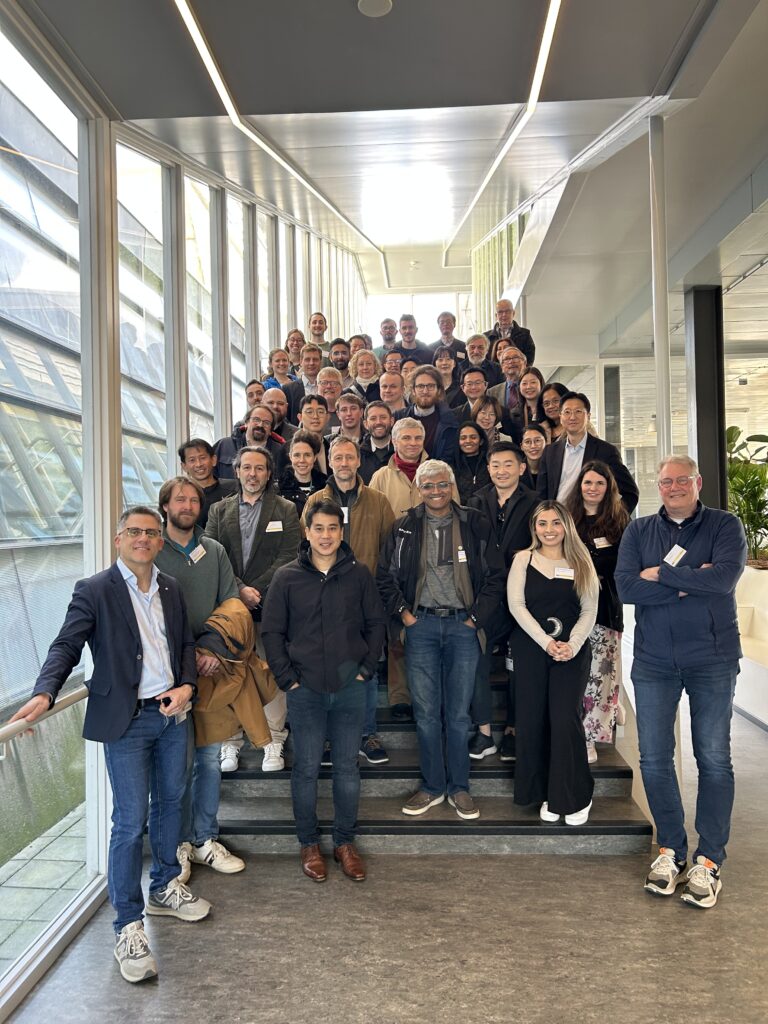
At the Lorentz Center workshop “Sonomechanobiology: Understanding High Frequency Mechanostimulation” (17–21 March 2025, Oort Building, Leiden), PhD candidate Alejandra Riveros Cortés presented her research on the interplay between fluid dynamics and soft biological materials during high-speed jet impact. The event was co-organized by her supervisor, Prof. Dr. ir. David Fernández Rivas, bringing together an interdisciplinary community working at the intersection of fluid mechanics, mechanobiology, and biomedical engineering.
The workshop focused on understanding how cells and tissues respond to high-frequency mechanical stimulation (>20 kHz), with the broader goal of advancing applications in tissue engineering, drug delivery, neuromodulation, and sonogenetics. Through intensive discussions and collaborative sessions, participants worked toward defining a roadmap for this emerging field.
Alejandra’s poster, “Fluid–Soft Matter Interactions of a High-Speed Jet Impacting Skin Scaffolds for Needle-Free Applications”, highlighted new experimental insights into how engineered skin scaffolds respond to rapid jet impact—a process central to needle-free injection technology. Using a microfluidic device, high-speed glycerol jets were produced at controlled energy levels. The skin scaffolds, composed of Collagen I matrices seeded with fibroblasts, were subjected to jet impact to study deformation, penetration behavior, and cell–material interactions. The experimental setup included hydrophobic surfaces with tailored contact angles to better understand jet spreading and liquid–biomaterial interactions.
This work contributes to ongoing efforts to design gentler, more precise needle-free delivery systems by revealing how soft tissue models behave under extreme, localized mechanical loads. The research showcased at the workshop underscores the importance of combining physics, biology, and engineering to develop the next generation of high-precision biomedical technologies.